How to Earn Extra Cash Doing AI Data Labelling and Model Training Tasks From Home in Australia
In her first month on Remotasks, a Brisbane primary school teacher named Sarah earned $43 USD — roughly $66 AUD once PayPal had taken its cut on the conversion. She'd read a few breathless articles promising "$30 an hour from your couch" and felt, understandably, a bit ripped off. What those articles didn't mention is that by month six, working two platforms and having qualified for higher-tier language tasks, she was clearing closer to $700 AUD a month. The disappointing start wasn't a sign she'd failed. It was just the shape of how this work actually pays.
That gap — between the headline rate and what lands in an Australian bank account — is the whole story here, and it's the part most articles skip entirely.
General information only. Income figures in this article are estimates based on publicly available reports and community discussions — results vary significantly based on effort, niche, and market conditions. This is not financial, legal, or tax advice. For guidance specific to your situation, consult the ATO, a registered tax agent, or a qualified professional.
What you're actually doing when you "train AI"
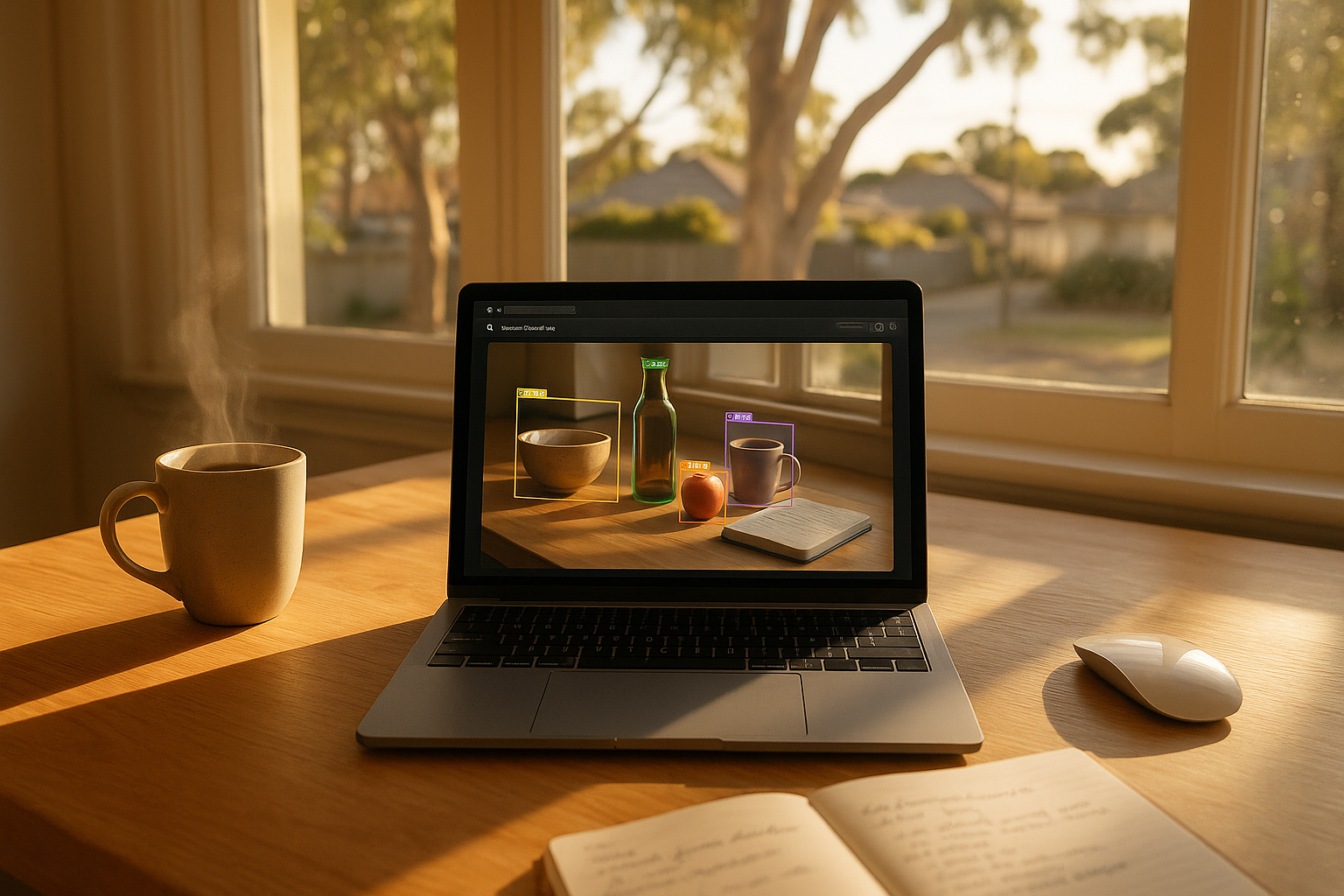
Every large language model and image generator you've used was taught by people doing repetitive, often tedious human work. Someone drew boxes around pedestrians so a self-driving car could recognise them. Someone transcribed garbled audio. And increasingly, someone read two AI-generated answers to a question and judged which one was more helpful, more accurate, or less likely to cause harm.
That last category — ranking and evaluating model outputs — is called RLHF, or Reinforcement Learning from Human Feedback, and it's where the real money in this space has moved. Companies like OpenAI, Anthropic and Google can't build better models without humans grading the output. They pay platforms, who pay contractors, who are increasingly people sitting at kitchen tables in Adelaide and Newcastle.
The work splits roughly into two tiers. Basic annotation — image tagging, bounding boxes, audio transcription — is the entry rung, and frankly it's being squeezed. It pays $3–$8 USD an hour equivalent, it's heavily offshored, and parts of it are being automated by the very models it once trained. The higher tier — evaluating LLM responses, writing adversarial prompts, fact-checking model output — pays meaningfully more because it needs strong written English and genuine judgement. That's the bit Australians are well-placed for, and it's the bit worth aiming at.
Is it legit, and what does it really pay in AUD?
Short answer: yes, it's legitimate, but the income is modest and uneven, especially early on.
Here's the realistic trajectory I see in the data annotation jobs Australia space. In your first one to three months on micro-task platforms like Toloka or Amazon Mechanical Turk, expect somewhere between $150 and $300 AUD a month. That assumes you're logging in consistently and the exchange rate is being kind to you — most tasks are priced in USD, and at roughly 0.65 AUD/USD, a $15 USD hourly rate becomes about $23 AUD before fees.

Six to twelve months in, working across two or three platforms and handling higher-complexity NLP and audio tasks, $500–$900 AUD a month is a fair expectation. The top 10% — people with demonstrated RLHF skills, domain expertise, or who've qualified for expert annotation queues — push into $1,500–$1,800 AUD a month at rates of $25–$45 USD an hour. That ceiling is real, but it's earned over months, not weeks, and it's not the median experience.
Let me do the maths nobody else does. Say you complete 10 hours of Remotasks work this month at $15 USD an hour. That's $150 USD. PayPal converts it at a rate roughly 3% below mid-market, so you receive about $145 USD worth of value, landing as roughly $94 AUD. Then it's assessable income, taxed at your marginal rate. If you're already earning a salary and this sits on top at 32.5%, your take-home from that batch is closer to $63 AUD. Still worth having — but a long way from "$15 an hour."
Platforms that actually accept Australians
Appen was the obvious starting point for years — it was founded in Sydney in 1996 and built the local industry. I'd be doing you a disservice not to flag that the company has had a brutal few years: its share price collapsed from over $40 AUD in 2020 to under $1 by 2024, and Australian contractors on Whirlpool have repeatedly described projects being cancelled mid-engagement during its 2023–2024 restructuring. You can still find work through appen.com, but treat it as one option among several, not a stable employer.
TELUS International (which absorbed Lionbridge's AI work) is now one of the more active platforms for Australians, with "AI Trainer" and "Search Engine Evaluator" roles that are among the more accessible entry points. Prolific (prolific.com) pays for participating in research studies and academic surveys — lower volume, but transparent rates and a good reputation. Outlier (outlier.ai) and Scale AI's Remotasks (remotasks.com) are where the RLHF and LLM work concentrates, though Australian access can be inconsistent and some task categories are region-gated. Toloka rounds out the entry tier with genuine micro-tasks — cents each, but a distributed global queue that's friendlier to our time zone than most.
The time-zone problem nobody warns you about
This is the friction point that destroys credibility when articles ignore it, so let's be straight. Most of these platforms are American. Their task queues refresh during US business hours — roughly 9am to 5pm Eastern, which in summer translates to about 1am to 7am AEST. By the time you sit down with your coffee at 8am, the highest-paying batches have been claimed by workers in the US and Asia.
One Brisbane contractor on Whirlpool described earning just $47 in their first month before realising the problem. Their fix was unglamorous: setting a phone alarm for 2:30am to catch fresh queues, grabbing an hour of premium tasks, then going back to bed. That's not for everyone, and I wouldn't pretend it is.
The workarounds that don't involve wrecking your sleep: lean on platforms with distributed or always-on queues (Toloka and Prolific are far less US-clock-dependent than Remotasks), and target specialised RLHF projects where you're assigned ongoing work rather than competing for batch drops. If you're in Victoria or NSW with solid NBN coverage, you'll also have a slight latency edge on time-sensitive queues — minor, but real.
Getting paid — and what the ATO expects
Payment almost always comes in USD via PayPal, sometimes Payoneer. Remotasks has historically had a $5 USD minimum withdrawal. Payoneer charges around 2% on AUD withdrawals; PayPal's conversion sits 3–5% below the mid-market rate. Budget for losing 3–5 cents in every dollar to currency friction before tax even enters the picture.
On tax — and this is where I see people get caught out — every dollar is assessable income, converted to AUD at the exchange rate on the date you received it. There's no "it's only a few hundred bucks" exemption. Both PayPal and Payoneer report transaction data to the ATO automatically under the OECD Common Reporting Standard, so the assumption that small foreign payments fly under the radar is simply wrong. Income tax obligations start from your first dollar.
Most legitimate platforms ask for an ABN or tax identification, and getting one is free through abr.gov.au. The $75,000 GST registration threshold is separate — you only need to register for GST if your self-employment turnover crosses it, which is unlikely on labelling income alone, but worth knowing. I've written a fuller breakdown in Do You Need an ABN for AI Side Income? What the ATO Actually Requires in 2026, and as general guidance you can always verify your current obligations at ato.gov.au or with a registered tax agent.
One thing worth claiming back: the ATO's fixed-rate method lets you deduct 67 cents per hour for working-from-home running costs, provided you keep a log of hours. Keep that log from day one — it's the difference between a clean tax return and guesswork in October.
How to actually earn more
The single biggest lever is moving off basic image work and onto language and reasoning tasks. One r/AusFreelance contributor described progressing from Remotasks image tagging at about $4 USD an hour to Scale AI RLHF work at $22 USD an hour over roughly six months — a 5x jump from the same desk. The pathway is concrete: complete the basic qualification tests cleanly to build a track record, then apply for projects that screen for written English, critical reasoning, or domain expertise. If you've got a background in law, medicine, coding or linguistics, platforms like Surge AI and Invisible AI specifically want you, and that's where the $25–$45 USD rates live.
Protect your account like it's your job, because it sort of is. Rushed, low-quality annotations get flagged, and a low accuracy score can see you quietly removed from a platform with no warning. Read the guidelines properly, don't multi-account, and never use a VPN to fake your location — that's the fastest route to a permanent ban.
It's also worth knowing this work offers no superannuation, like most platform gig income — part of the $33 billion in super Australian workers forgo annually. If this becomes a meaningful income stream, voluntary super contributions are worth a conversation with someone qualified.
Is it worth it in 2026?
As a standalone income, it's modest and the early months are genuinely discouraging — Sarah's $66 first month is closer to typical than the $1,800 ceiling. As a flexible top-up you can do around shifts, study or kids, it holds up, particularly if you climb to the RLHF tier where the rates start to mean something. It's similar in spirit to the path stay-at-home parents take in AI transcription and editing work: unglamorous, real, and better the longer you stick with it.
Go in expecting $200 in month one and a slow climb. That's the honest version, and it's the one worth backing.
Author